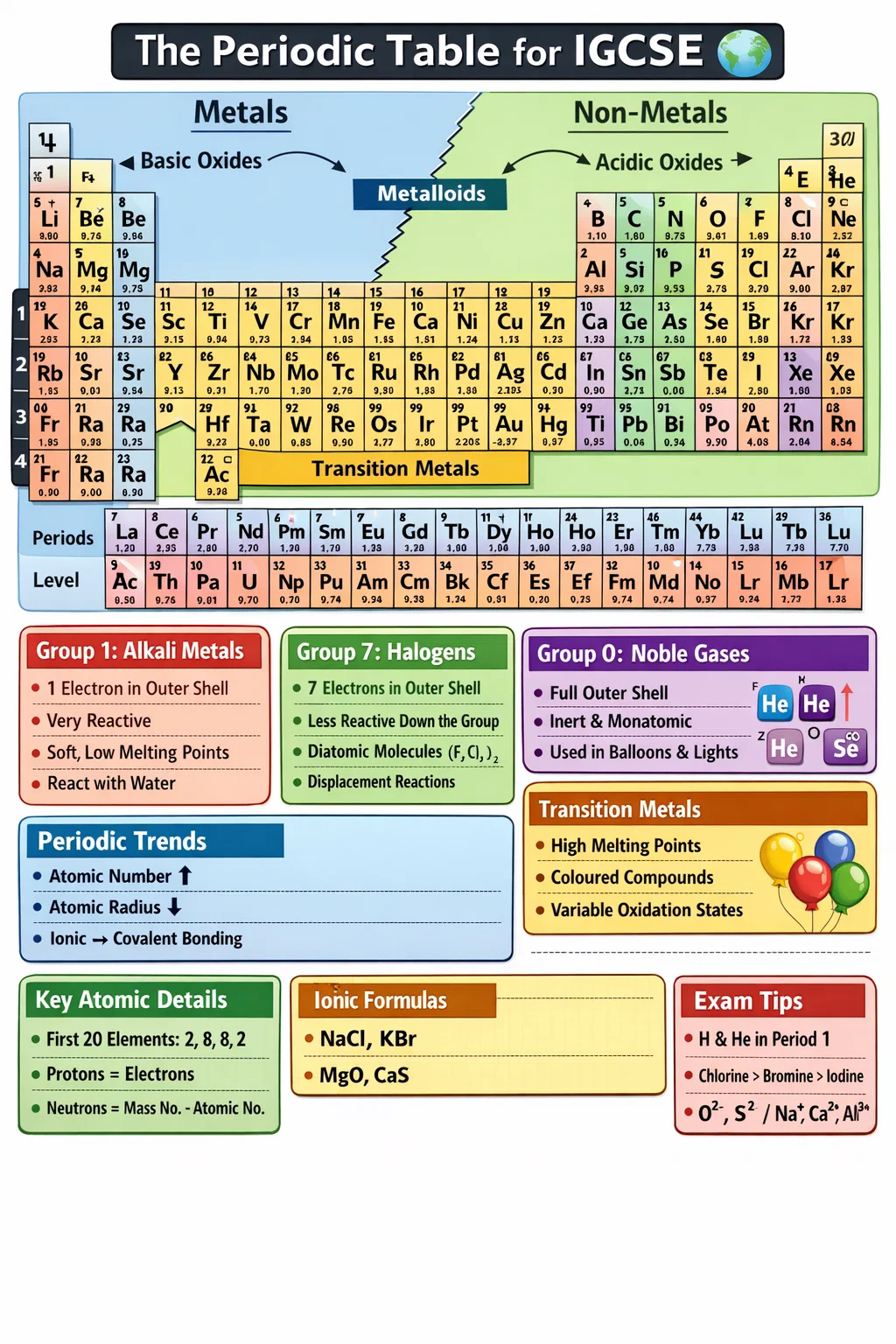
Created by @foodssystem on Sora AI
create a periodic table to have all information ,so i can memorize and remember for IGCSE exam: 1. Structure and Organization Atomic Number (Proton Number): Elements are arranged in order of increasing atomic number (the smaller number in each box). Groups (Vertical Columns): Elements in the same group have the same number of outer-shell electrons (valence electrons), which means they share similar chemical properties. Periods (Horizontal Rows): Elements in the same period have the same number of electron shells. Metals vs. Non-metals: Metals are on the left and middle; non-metals are on the top right. A zig-zag line separates them (Metals = Basic Oxides, Non-metals = Acidic Oxides). 2. Group Specific Properties (Must Know) Group I (Alkali Metals - Li, Na, K...): One electron in outer shell, form ions. Trends: Reactivity increases down the group (easier to lose the outer electron). Properties: Soft, low density, low melting points (melting points decrease down the group). Reactions: React with water to produce hydrogen gas and a metal hydroxide (alkaline solution). Group VII (Halogens - F, Cl, Br, I...): Seven electrons in outer shell, form ions (gain one electron). Trends: Reactivity decreases down the group (harder to attract an electron). Physical State: Darken in color and become harder (Gas Liquid Solid) down the group. Diatomic Molecules: Exist as . Displacement Reactions: A more reactive halogen displaces a less reactive one from a halide solution ( ). Group 0 (Noble Gases - He, Ne, Ar, Kr...): Full outer electron shells (stable/inert). Monatomic (exist as single atoms, not molecules). Uses: Helium in balloons (low density/non-flammable), Argon in light bulbs (inert atmosphere). Transition Metals (Center Block): High melting points, high density, act as catalysts (e.g., Iron in the Haber process). Form coloured compounds and have variable oxidation states (e.g., and ). 3. Periodic Trends (Across a Period) Atomic Number increases (more protons). Atomic Radius decreases (stronger nuclear charge pulls electrons closer). Metallic character decreases (metals metalloids non-metals). Bonding changes from ionic to covalent across the period. 4. Key Atomic Details (Top 20 Elements) Protons & Electrons: Atomic Number = Number of Protons = Number of Electrons (in a neutral atom). Neutrons: Nucleon Number (Mass Number) Atomic Number Number of Neutrons. Electronic Configuration: For the first 20 elements, fill shells 2, 8, 8, 2. Formula of Ionic Compounds: Group I + Group VII ( and ); Group II + Group VI ( and ). +4 5. Essential Exam Tips Hydrogen & Helium: Remember both are in Period 1. Group VIII/0: Remember they are non-reactive. Displacement Rules: Chlorine displaces Bromine; Bromine displaces Iodine. Anion Charges: Halogens ( ) form , Oxygen/Sulfur ( ) form . Cation Charges: Metals form positive ions equal to their group number ( ).
Explore more AI-generated masterpieces from our collection.